As explained earlier, in the two-tier Client/Server model, the business logic goes either with the client, or with the server or split between both. Even though the two-tier Client/Server model has advantages over the conventional model, still it has it’s own limitations. The first and most limitation would be the maintainence and distribution.
For example, say, the application is using Sybase SQL Server and PowerBuilder. Say, all the business logic is put on the SQL server in the form of Stored Procedures and triggers. What happens if the management decides to migrate from Sybase to another database. All the data has to be converted into the new database and also all the business related code need to be written in the new database, even though there is no change in the actual business code. Let’s see what happens when we put the business code in the client application. If there is a simple change in the business logic, you need to distribute the new version of the client application to all the users which is more difficult and time consuming job.
In the three or n-tier Client/Server model, we clearly divide into three parts, one application contains the presentation, navigation & GUI logic only. The other would be only the application logic (business logic). The data server just stores the data, contains no business code.
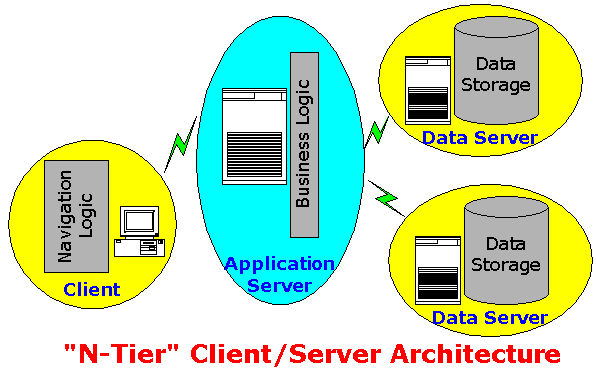
In this model, the business logic is encapsulated and put on a different server. You don’t have to do any changes in the business related code, when you migrate your client or server to other brands. Any changes that you do to the business logic can be implemented very fast compared to the client application distribution to hundreds of users. The end-user don’t have the need of high powered client machine, since all the data business logic and calculations are being done in the application server. The big benifit is the scalability. When your business expands and add hundreds of users, you can add more and more servers and route the requests from one application server depending on the load on other servers; This would be transparent to the end-user, and also, the client machine always contacts only one server; That means, there is no need to do any change in the client application.