The term Client/Server has several definitions in several contexts. In our context, two different applications run either on the same machine or other machine and both of these applications talk to each other. One application acts as a server, and the other machine as a client.
A typical example for the server application would be a database server. It listens requests from the clients and sends the results back to the client. Typically a server application is located on a machine which has a lot more horse-power and serves to lot of clients.
Another application acts as a client application and typically loaded on a normal machine. The client application makes requests to the server application. For example, a PowerBuilder application sending a SQL query to the database and displaying the results on the screen.
The OLE context has a little different definition, but, we won’t be going into OLE now. We won’t be teaching the evoluation of computers, but, we need to tell about the conventional computers in few sentences.
Conventional applications run in the same memory space. For example, a CICS/COBOL application that runs on a dumb terminal. You need to run that application only on a IBM mainframe terminal. Even if you run the application on your powerful penitium machine using a terminal emulator, still, the actual application runs on the mainframe, not on your PC. That means, you can’t use your powerful desktop machine, it is just useless when you run the CICS application. On the other hand when applications are designed as per the Client/Server architecture, you don’t have to through away your PC. In the Client/Server architecture, as long as the client and the server is able to talk, it doesn’t matter on which platform the applications are running.
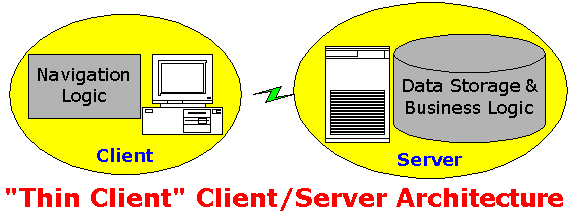
We can divide an application into three logical parts, Presentation, Business logic, data handling. In conventional applications such as COBOL/CICS, all these three parts are part of one application. In Client/Server applications, the client application contains the presentation logic, data handing is done in the server application. The business logic goes either in the client or in the server or split between both the client and server application.
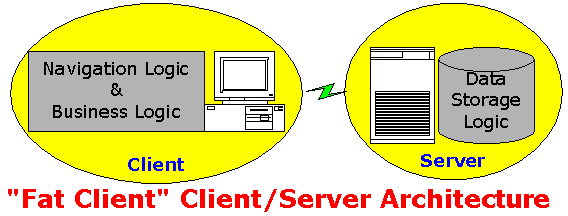
When all the business logic is put in the client application, it is called FAT client model. On the other hand when all the business logic is put in the server application, it is called THIN client model. Where exactly should the business logic should go is the choice of the origanization.