
| Home | Previous Lesson: Defining Pipeline User Object Next Lesson: DataStore Object |
Paint a window as shown in the picture below:
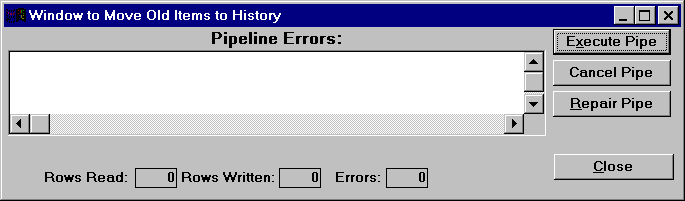
Window to move obsolete products to history table.
The window has a DataWindow "dw_error". All the controls in the right hand side are CommandButtons", "cb_execute", "cb_cancel", "cb_repair", "cb_close". The rest are StaticText controls. Name the StaticText controls in the bottom which are shown with border as "st_read", "st_written" and "st_errors" ( from left to right ). Save the window as "w_move_to_history". Please note that, no DataWindow object is associated with "dw_error" DataWindow.
Declare the following instance variables:
uop_copy_to_history
ip_CopyToHistory
Transaction it_Target
Write the following code to the window's Open event:
// Object:
w_move_to_history it_Target = CREATE Transaction it_Target.dbms =
sqlca.dbms Connect using it_Target; ip_CopyToHistory = CREATE
uop_copy_to_history |
In the above code, we have created a new transaction object. This is require because, we need two transaction objects for the data pipeline execution, one for connecting to the source database and another for connecting to the target database. Actually, we are connecting to the same database "product" in this example.
After creating the transaction object, we are populating the values from the SQLCA, since we are connecting to the same database. Similarly, we have created an user object of type "uop_copy_to_history". Then we set the instance variables that we have declared in the user object for displaying the status.
Write the following code for the window Close event.
// Object:
w_move_to_history If IsValid(
ip_CopyToHistory ) Then DESTROY ip_CopyToHistory |
In the close event, we are destroying the objects that we have created in the open event.
// Function:
wf_delete_old_products Event: Clicked ls_SQLStatement = & IF SQLCA.SQLCode = 0 THEN |
In this function we are deleting all obsolete products from the "product_master" table.
// Object: cb_execute Integer li_ReturnStatus SetPointer( HourGlass! ) This.Enabled = False li_ReturnStatus=ip_CopyToHistory.Start(
SQLCA, & If li_ReturnStatus
<> 1 Then li_ReturnStatus =
wf_delete_old_products() This.Enabled = True |
In the above code, we are actually executing the pipe object by calling Start() function. This function takes three parameters. Source transaction object, target transaction object and the DataWindow name in which it has to display any errors. PowerBuilder automatically creates the DataWindow depending on the errors and displays in the specified DataWindow.
Once copying is successful, we are calling a function in which we deleting all the copied rows from the "product_master" table. If everything is successful, then we are committing otherwise, we are rolling back the changes.
What happens when there is error. PowerBuilder displays all the errors in the DataWindow. User can then do appropriate changes and click on the "Repair" button.
// Object: cb_repair Integer li_RetStatus li_RetStatus =
ip_CopyToHistory.Repair( it_Target ) Rollback Using it_Target ; Return 1 |
Repair() function takes the target transaction object as the parameter and applies the changes that are done to the errors in the target database.
// Object: cb_cancel ip_CopyToHistory.Cancel() |
If user wants to cancel by any reason, he can do so by clicking on the "Cancel" CommandButton. We are calling the Cancel() function at the pipeline object and rolling back any changes that are made.
That's all. In the open event of the application object, append the following code for testing purpose and run the application.
Open( w_move_to_history )
You will see that 0 rows are copied, since there is no obsolete product. Open the product master window at run-time and prefix few products description with "obsolete" and save it. Then run the pipe object.
You might get some errors when you try to delete any products that have transactions. This is because of the referential integrity we have declared using the foreign keys in the database. Just for the purpose of testing, add few new products in the product_master table with "obsolete" prefix in the description and try it.
| Home | Previous Lesson: Defining Pipeline User Object Next Lesson: DataStore Object |
 SQLCA.uf_Display_Error()
 Commit
Using it_Target ;
Commit
Using it_Target ;