| Home | Previous Lesson: Instances Next Lesson: Concrete Class |
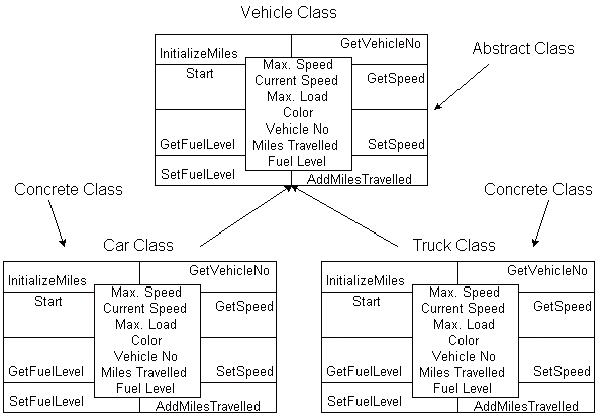
An abstract class, simply stated as a catalog of common services and attributes. It is the one in which there is no physical representation of its associated object. In other words, the object associated with an abstract class can have no instances. Abstract classes are formed to represent the common services and attributes extracted from objects during classification and are the upper-level classes in an inheritance (we will explain in a moment) hierarchy. The distinguishing feature of an abstract class is that it always has subclasses.
Abstract classes are often used to define default process services and to set the initial conditions of data attributes of the objects associated with its subclasses. The services and attributes contained in an abstract class tend to be separate and distinct from one another. They are merely cataloged together because they all serve the same set of lower-level objects. Each has its own internal design, which can be modified at any time without disrupting the integrity of the design of the other objects. Just as the services and attributes of an abstract class can be used in its subclass objects, an abstract class can make use of the services and attributes from a higher-level abstract class to which it is a subclass.
| Home | Previous Lesson: Instances Next Lesson: Concrete Class |